This is the pattern for the earrings I showed in previous post, only text.
CTM= continuous thread method;
ds=double stitch;
tds=treble tatting stitch;
hidden picot= a very small picot every each tds;
LJ= lock join;
JSS= Join to the Smooth Side (Anne Dyer's join)
Elements in this pattern:
- Spiral ring with treble tatting;
(UPDATE to add link: https://ninettacaruso.blogspot.com/2018/08/spiral-rings-with-treble-tatting.html )
- Mock ring (SCMR);
- Curled ring;
- SSSR.
I chose to tat the centre and the contour in 2 different colours.
Start with one shuttle, Spiral ring: 1ds, 12tds.
Left and right earring can be tatted symmetrically, depending if you post, or don't post, the shuttle inside the spiral ring before closing it.
In my next pictures, I inserted the shuttle inside the loop around the hand. You should do yourself the other earring.
I closed the spiral ring, joining the hidden picot between the 8th and the 9th tds (there are 4 tds before the joining picot, if you count from the last tatted)
Cut the thread if you like to change colour.
I wound 2 shuttles CTM with the white thread, then I made a lock join with one shuttle to the same hidden picot where I closed the spiral ring. I hid the tail inside the first stitches in next chain.
Chain1: 25ds.
Mock ring: 3ds, picot (here it is where you can put a bead), 3ds.
Chain2: 8ds, JSS (in the hidden picot of the ring, between the 3rd and 4th tds), 12ds, LJ to the starting point of this outer round.
Without reversing work,
Chain3: 5ds
Curled ring: 6ds, picot, 6ds, close.
After that, I closed the curled ring around the Chain1 and ended the pattern finishing with an SSSR (Miranda's method) of 6ds/6ds.
Ciao,
Ninetta
UPDATE: Please refer to the page "Treble Tatting Stitch - Summary" - https://ninettacaruso.blogspot.com/p/blog-page_95.html for any info about treble tatting stitches, thank you.
Handmade tatting lace blog with my own patterns, tutorials, how-to and links to useful resources. It's all about my passion and my joy.
Translate
====================
====================
Dear Reader,
I share here what I like and what works for me. If you've been following me, you know that I can change my mind from time to time, and feel free to comment that I'm completely wrong, you may be right. I'm not running a business. I'm not paid and have never received any compensation or facilitation for any review/brand/site here mentioned. In case one day we'll ever meet, I'll be the one offering you a cup of Italian coffee, too.
====================
Tuesday, 29 January 2019
Tuesday, 22 January 2019
ready and steady for Valentine
These are ready and in time for Valentine's Day!
Red thread is 2 strands of DMC Mouliné Metallisé, Jewel Effects, number E321, sold in skeins.
Gold thread is 2 strands of Finca metallic gold colour 0006 n.2/C.
I'll put the pattern in Flickr, soon. In the meantime, I'm already wearing them, just the size I like!
And then, I'm very ready for an upcoming event: on February 2nd, I will be teaching one day course about the treble tatting stitch, at the local lace's association, I'll teach an original unpublished pattern of mine, that, I'm sorry, I won't share online.
Ciao,
Ninetta
UPDATE: pattern is here: https://ninettacaruso.blogspot.com/2019/01/pattern-ready-for-valentine.html
Red thread is 2 strands of DMC Mouliné Metallisé, Jewel Effects, number E321, sold in skeins.
Gold thread is 2 strands of Finca metallic gold colour 0006 n.2/C.
I'll put the pattern in Flickr, soon. In the meantime, I'm already wearing them, just the size I like!
And then, I'm very ready for an upcoming event: on February 2nd, I will be teaching one day course about the treble tatting stitch, at the local lace's association, I'll teach an original unpublished pattern of mine, that, I'm sorry, I won't share online.
Ciao,
Ninetta
UPDATE: pattern is here: https://ninettacaruso.blogspot.com/2019/01/pattern-ready-for-valentine.html
Etichette:
"curled ring",
agofiloefuselli,
earrings,
jewellery,
JSS,
spiral ring,
treble,
zoliduo
Tuesday, 15 January 2019
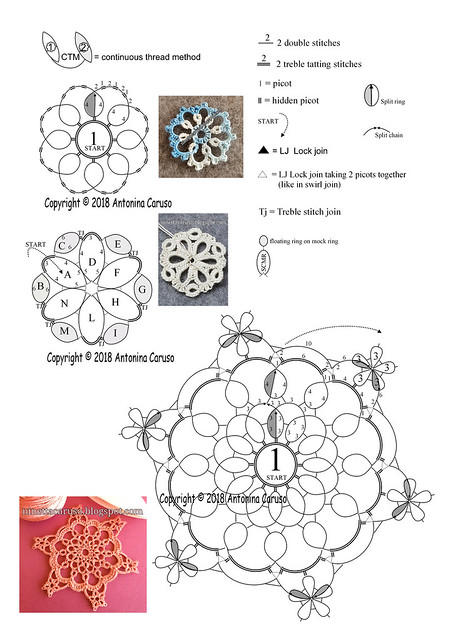
visual patterns for little motifs with treble tatting stitches

Ciao,
Ninetta
Update:
textual patterns: For the little light blue one: ninettacaruso.blogspot.com/2018/07/treble-tatting-ideas.html For the little one with SCMRs: ninettacaruso.blogspot.com/2018/07/more-ideas-part-iii.html . There is an oversight in this second drawing: picots in the floating rings have to be normal picots, that is they would have been single line picots in the drawing - and not hidden picots/double line. They are joined afterwards with Tj. hidden picot= a very small picot every each tds, also between adjacent ds and tds (or tds and ds, as well); I've introduced the hidden picot here: ninettacaruso.blogspot.com/2018/08/spiral-rings-with-treb... In the diagram, only hidden picots that are used to be joined to a next element are showed. Tj = treble stitch join. For how to join a tds to a previous element, refer to this post by Muskaan (she shows us two methods, mine and hers): tipsaroundthehome.blogspot.com/2018/07/multiples.html
I also forgot to draw a different symbol for the false tds, to climb on to the next row, from the centre to the split ring, I'm very sorry.
UPDATE: Please refer to the page "Treble Tatting Stitch - Summary" - https://ninettacaruso.blogspot.com/p/blog-page_95.html for any info about treble tatting stitches, thank you.
bit by bit
I'm very slow tatting, lately. Gradually, I hope that all WIPs will turn to finished objects instead of UFOs. I've almost finished the bedspread for the dollhouse, forgot where the swirling butterflies doily is, and still got bogged down by the treble tatting project (if you like, read my own definitions of WIP and UFO here: https://ninettacaruso.blogspot.com/2017/12/spread.html)
Today I only have samples to show you.
There are daisy picots and also daisy picots with unflipped stitches, in which I tried to mix double and treble stitches.
Actually, daisy picots are called picots but they are like chains, as they involve tatting unflipped stitches on the thread that is used for picots. It is like in Maltese ring tatting, both techniques have unflipped stitches made with a second thread, but there is a difference. There's a post by Miranda (here: https://tattingfool.blogspot.com/2011/04/daisy-picots-and-maltese-rings.html), where she clearly explain that with the daisy picots, unflipped stitches are made on the thread around your hand, while, in Maltese rings, the unflipped stitches are made on the core thread.
I learnt (reading this page: https://palmettotatters.org/events/TATDAY2004/Teachers/MarkMyers.shtml) that "the daisy picot" is a technique developed by Gale Marshall (I suppose just before 2004, it could be 2003, because I found a reference to this technique in a blog post by Gina Brummet, dated 2003).
Those stitches (they can be double or treble stitches), tatted on the picot, can also be done in a normal way, that is flipped. That technique, I learnt from other tatters, they called it "dsop" (double stitches on picot) by G&R Houtz, in their book from 2009, "Tatting GR-8 Alternate Threads". Unfortunately, I still haven't bought the book, but here it is a link: https://www.gr-8shuttles.com/ATbook.shtml
In my picture, 1,4 and 5 are examples of daisy picots, white thread is the chain thread (second shuttle) and then stitches are unflipped.
Then, in samples 2, 3 and 6, there are daisy picots with flipped stitches.
May I call those tds on picot, in my sample 3, "tsop"? What do you think?
Ciao,
Ninetta
Today I only have samples to show you.
There are daisy picots and also daisy picots with unflipped stitches, in which I tried to mix double and treble stitches.
Actually, daisy picots are called picots but they are like chains, as they involve tatting unflipped stitches on the thread that is used for picots. It is like in Maltese ring tatting, both techniques have unflipped stitches made with a second thread, but there is a difference. There's a post by Miranda (here: https://tattingfool.blogspot.com/2011/04/daisy-picots-and-maltese-rings.html), where she clearly explain that with the daisy picots, unflipped stitches are made on the thread around your hand, while, in Maltese rings, the unflipped stitches are made on the core thread.
I learnt (reading this page: https://palmettotatters.org/events/TATDAY2004/Teachers/MarkMyers.shtml) that "the daisy picot" is a technique developed by Gale Marshall (I suppose just before 2004, it could be 2003, because I found a reference to this technique in a blog post by Gina Brummet, dated 2003).
Those stitches (they can be double or treble stitches), tatted on the picot, can also be done in a normal way, that is flipped. That technique, I learnt from other tatters, they called it "dsop" (double stitches on picot) by G&R Houtz, in their book from 2009, "Tatting GR-8 Alternate Threads". Unfortunately, I still haven't bought the book, but here it is a link: https://www.gr-8shuttles.com/ATbook.shtml
In my picture, 1,4 and 5 are examples of daisy picots, white thread is the chain thread (second shuttle) and then stitches are unflipped.
Then, in samples 2, 3 and 6, there are daisy picots with flipped stitches.
May I call those tds on picot, in my sample 3, "tsop"? What do you think?
Ciao,
Ninetta
Tuesday, 8 January 2019
tatting movements and stitches
****** Happy New Year! ******
Please, N.B. : This post is my own perspective on defining/dissecting tatting stitches through movements.
My special thanks goes to Muskaan, her help has been precious to clarify the rough concept that I had in mind (and also to put it in a good English 😊).
Please read also my other post about tatting stitches and techniques, here:
https://ninettacaruso.blogspot.com/2018/06/differences-between-stitch-and-technique.html
❀❀❀❀❀❀❀❀❀❀
In order to state that the treble tatting stitch is a valid tatting technique, and trying to do my best to rationalize things up, I now want to reassure traditional tatters...1. Tatting has just 2 basic movements: the first half stitch and the second half.
Note: Basic picots are not movements, nor stitches, they are just bare thread.
2. Those 2 basic movements, plus only one additional movement that is the twist, can be combined so that they make few basic techniques, that are the so called basic stitches of our lace. The twist can be done with the core thread, or the ball thread, or both.
Then:
3. The way the stitches (basic techniques) are combined and connected with each other, forms the variable part; those combinations are true techniques, not stitches. (It is a fact that there are many technical solutions to the same problem, for example there are various types of joins.)
Note: Joins involve a 4th basic movement of pulling a loop and passing a thread through (that is, the shuttle for shuttle tatters and the needle for needle tatters).
4. It is due to this variability that a design can be executed in more than one way or even have a different finishing appearance. For example, a different effect can be achieved by changing only the bare threads, or the technique to make decorative picots.
Please note that:
5. I'm not talking about design elements, that usually means rings and lines, but there's more. Design elements can be tatted using any technique (stitches or true techniques). For example, onion rings, pearl tatting, block tatting, split rings, curled rings,... are design elements.
********************
In this perspective, reading point 2., traditional double stitch is a combination of 2 basic movements, and the treble tatting stitch combines 3 basic movements, hence it can be called stitch and is a valid basic technique. If not, so why English speaking people had the need to baptize as stitches the Lock Stitch, that is another combination of the 2 basic movements, or the Padded Double Stitches that are featuring also the twist, or Double Double Stitch?
![]() |
| Rose motif, pattern at page 15 of Priscilla Tatting #3, with "Priscilla's knot stitch" tatting |
![]() |
| Edging tatted with "Dora Young's knot stitch", explained in her book "All new knotless tatting designs". |
I sincerely think that tatting is still evolving and there is a set of techniques that are internationally accepted and named, while another set is subjected to different approaches, like, for example, different names for the same technique. I'm trying to explain tatting in a new way, that is moving far from the rings-and-chains definition, focusing on movements and stitches, instead. That’s nothing new, in fact also crochet and knitting and bobbin lace use the term “stitches” for their techniques.
And to think that someone had called it the lost art!
🦋🦋🦋🦋🦋🦋🦋🦋🦋🦋
Next post will be about treble tatting stitches in rings with daisy picots, but here it is a sneak peek of what I'm tatting right now:Ciao,
Ninetta
Subscribe to:
Comments (Atom)
Thank you very much for all your nice comments.
Ciao
Ninetta
Ninetta